

Surrealist cinema is a modernist approach to film
theory, criticism, and production with origins in Paris in the 1920s. Related
to Dada cinema, Surrealist cinema is characterised by juxtapositions, the
rejection of dramatic psychology, and a frequent use of shocking imagery. The
first Surrealist film was The Seashell and the Clergyman from 1928, directed by
Germaine Dulac from a screenplay by Antonin Artaud. Other films include Un
Chien Andalou and L'Age d'Or by Luis Buñuel and Salvador Dalí;
Buñuel went on to direct many more films, with varying degrees of Surrealist
influence.
Definition
of surrealism:
The principles, ideals, or practice of producing fantastic
or incongruous imagery or effects in art, literature, film, or theater by means
of unnatural or irrational juxtapositions and combinations.
History:
Surrealism was the first literary
and artistic movement to become seriously associated with cinema, though it has
also been a movement largely neglected by film critics and historians.
The foundations of the movement
coincided with the birth of motion pictures, and the Surrealists who
participated in the movement were among the first generation to have grown up with
film as a part of daily life.
Breton himself, even before the
launching of the movement, possessed an avid interest in film: while serving in
the First World War, he was stationed in Nantes and, during his spare time,
would frequent the movie houses with a superior named Jacques Vaché.According
to Breton, he and Vaché ignored movie titles and times, preferring to drop in
at any given moment and view the films without any foreknowledge. When they
grew bored, they left and visited the next theater. Breton’s movie-going habits
supplied him with a stream of images with no constructed order about them. He
could juxtapose the images of one film with those of another, and from the
experience craft his own interpretation.
Referring to his experiences with
Vaché, he once remarked, “I think what we [valued] most in it, to the point of
taking no interest in anything else, was its power to disorient. Breton
believed that film could help one abstract himself from “real life” whenever he
felt like it.
Serials, which often contained
cliffhanger effects and hints of “other worldliness,” were attractive to early
Surrealists.Examples include Houdini’s daredevil deeds and the escapades of
Musidora and Pearl White in detective stories. What endeared Surrealists most
to the genre was its ability to evoke and sustain a sense of mystery and
suspense in viewers.
The Surrealists saw in film a medium
which nullified reality’s boundaries. Film critic René Gardies wrote in 1968,
“Now the cinema is, quite naturally, the privileged instrument for derealising
(sic) the world. Its technical resources... allied with its photo-magic,
provide the alchemical tools for transforming reality."
Surrealist artists were interested
in cinema as a medium for expression. As cinema continued to develop in the
1920’s, many Surrealists saw in it an opportunity to portray the ridiculous as
rational. Cinema provided more convincing illusions than its closest rival,
theatre, and the tendency for Surrealists to express themselves through film
was a sign of their confidence in the adaptability of cinema to Surrealism’s
goals and requirements.They were the first to take seriously the resemblance
between film’s imaginary images and those of dreams and the unconscious. Luis
Buñuel said, “The film seems to be the involuntary imitation of the dream.”
Surrealist filmmakers sought to
re-define human awareness of reality by illustrating that the “real” was little
more than what was perceived as real; that reality was subject to no limits
beyond those mankind imposed upon it. Breton once compared the experience of
Surrealist literature to “the point at which the waking state joins sleep.” His
analogy helps to explain the advantage of cinema over books in facilitating the
kind of release Surrealists sought from their daily pressures. The modernity of
film was appealing to as well.
Critics have debated whether
“Surrealist film” constitutes a distinct genre. Recognition of a
cinematographic genre involves the ability to cite many works which share
thematic, formal, and stylistic traits. To refer to Surrealism as a genre is to
imply that there is repetition of elements and a recognizable, “generic
formula” which describes their makeup. Several critics have argued that, due to
Surrealism's use of the irrational and on non-sequitur, it is impossible for
Surrealist films to constitute a genre.
While there are numerous films which
are true expressions of the movement, many other films which have been
classified as Surrealist simply contain Surrealist fragments. Rather than
“Surrealist film” the more accurate term for such works may be “Surrealism in
film.”
Surrealist
Films and Filmmakers:
Films
of the original movement

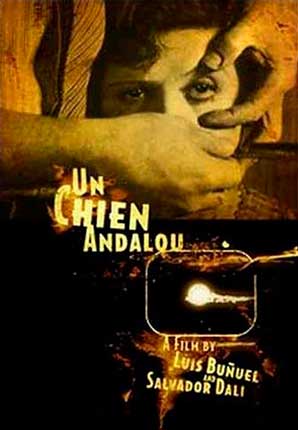
A man slices a woman’s eye in the
opening scene of Un Chien Andalou.
Later
films:

An image from Disney and Dalí's Destino
(1946)
Joseph Cornell produced surrealist
films in the United States in the later 1930s (such as Rose Hobart in
1936). Antonin Artaud, Philippe Soupault, and Robert Desnos wrote screenplays
for later films. Salvador Dalí designed a dream sequence for Alfred Hitchcock's
film Spellbound (1945).
In 1946, Dalí and Walt Disney began
work on a film called Destino; the project was finally finished in 2003.
Surrealism:
 Surrealism was an avant-garde art
movement in Paris from 1924 to 1941, consisting of a small group of writers,
artists, and filmmakers, including André Breton (1896–1966), Salvador Dali
(1904–1989), and Luis Buñuel (1900–1983). The movement used shocking, irrational,
or absurd imagery and Freudian dream symbolism to challenge the traditional
function of art to represent reality. Related to Dada cinema, Surrealist cinema
is characterised by juxtapositions, the rejection of dramatic psychology, and a
frequent use of shocking imagery.
Surrealism was an avant-garde art
movement in Paris from 1924 to 1941, consisting of a small group of writers,
artists, and filmmakers, including André Breton (1896–1966), Salvador Dali
(1904–1989), and Luis Buñuel (1900–1983). The movement used shocking, irrational,
or absurd imagery and Freudian dream symbolism to challenge the traditional
function of art to represent reality. Related to Dada cinema, Surrealist cinema
is characterised by juxtapositions, the rejection of dramatic psychology, and a
frequent use of shocking imagery.
Critics
have debated whether 'Surrealist film' constitutes a distinct genre.
Recognition of a cinematographic genre involves the ability to cite many works
which share thematic, formal, and stylistic traits. To refer to Surrealism as a
genre is to imply that there is repetition of elements and a recognizable,
generic formula which describes their makeup. Several critics have argued that,
due to Surrealism's use of the irrational and on non-sequitur, it is impossible
for Surrealist films to constitute a genre or a style. In his 2006 book Surrealism
and Cinema, Michael Richardson argues that surrealist works cannot be
defined by style or form, but rather as results of the practice of surrealism.
Richardson writes: "Within popular conceptions, surrealism is
misunderstood in many different ways, some of which contradict others, but all
of these misunderstandings are founded in the fact that they seek to reduce
surrealism to a style or a thing in itself rather than being prepared to see it
as an activity with broadening horizons. Many critics fail to recognise the
distinctive qualities that make up the surrealist attitude. They seek something
– a theme, a particular type of imagery, certain concepts – they can identify
as 'surrealist' in order to provide a criterion of judgement by which a film or
art work can be appraised. The problem is that this goes against the very
essence of surrealism, which refuses to be here but is always elsewhere.
It is not a thing but a relation between things and therefore needs to be
treated as a whole.
Surrealists
are not concerned with conjuring up some magic world that can be defined as
'surreal'. Their interest is almost exclusively in exploring the conjunctions,
the points of contact, between different realms of existence. Surrealism is
always about departures rather than arrivals."
While
there are numerous films which are true expressions of the movement, many other
films which have been classified as Surrealist simply contain Surrealist
fragments. Rather than 'Surrealist film' the more accurate term for such works
may be 'Surrealism in film'.
Under the
leadership of poet Tristan Tzara, Dadaist publications, exhibitions, and
performances flourished during the late 1910s and early 1920s. The performance soirée
included such events as poetry readings in which several passages were
performed simultaneously. On July 7, 1923, the last major Dada event, the Soirée
du 'Coeur à Barbe' (Soirée of the ' Bearded Heart' ), included three short
films: a study of New York by American artists Charles Sheeler and Paul Strand,
one of Hans Richter's Rhythmus abstract animated works, and the
American artist Man Ray's first film, the ironically titled Le retour à la
raison (Return to Reason). The element of chance certainly entered into the
creation of Retour à la raison, since Tzara gave Ray only twentyfour
hours' notice that he was to make a film for the program. Ray combined some
hastily shot live footage with stretches of "Rayograms". The soirée
proved a mixed success, since Tzara's rivals, led by poet Andre Breton,
provoked a riot in the audience. This riot was symptomatic of the disagreements
that were already bringing Dada to an end."
Breton
had begun investigating Sigmund Freud's research into the unconscious and
wanted to bring his theories into the creative process of dada. Tzara saw
psychoanalysis as an instrument of mystification and bourgeois ideals, which he
felt to be counter to the dada anti-real; Breton felt that Tzara's lack of
seriousness was the cause for dada's approaching self-destruction, and he
wanted to reorganize and reinvigorate the movement. He incorporated his
interest in Freud with the automatic processes of dada art, resulting in the
new movement of surrealism.
 Even though by 1922,
dada was dead, key Dada films were still to come. "In late 1924, Dada
artist Francis Picabia staged his ballet Relâche (meaning
"performance called off"). Signs in the auditorium bore such
statements as "If you are not satisfied, go to hell." During the
intermission (or entr'acte), René Clair's Entr'acte was shown, with music by
composer Erik Satie, who had done the music for the entire show. The evening
began with a brief film prologue (seen as the opening segment of modern prints
of Entr'acte) in which Satie and Picabia leap in slow motion into a scene and
fire a cannon directly at the audience. The rest of the film, appearing during
the intermission, consisted of unconnected, wildly irrational scenes. Picabia
summed up the Dada view when he characterized Clair's film: "Entr'acte
does not believe in very much, in the pleasure of life, perhaps; it believes in
the pleasure of inventing, it respects nothing except the desire to burst out laughing."
Even though by 1922,
dada was dead, key Dada films were still to come. "In late 1924, Dada
artist Francis Picabia staged his ballet Relâche (meaning
"performance called off"). Signs in the auditorium bore such
statements as "If you are not satisfied, go to hell." During the
intermission (or entr'acte), René Clair's Entr'acte was shown, with music by
composer Erik Satie, who had done the music for the entire show. The evening
began with a brief film prologue (seen as the opening segment of modern prints
of Entr'acte) in which Satie and Picabia leap in slow motion into a scene and
fire a cannon directly at the audience. The rest of the film, appearing during
the intermission, consisted of unconnected, wildly irrational scenes. Picabia
summed up the Dada view when he characterized Clair's film: "Entr'acte
does not believe in very much, in the pleasure of life, perhaps; it believes in
the pleasure of inventing, it respects nothing except the desire to burst out laughing."
Dada
artist Marcel Duchamp made one foray into cinema during this era. By 1913,
Duchamp had moved away from abstract painting to experiment with such forms as
ready- mades and kinetic sculptures. The latter included a series of
motor-driven spinning discs. With the help of Man Ray, Duchamp filmed some of
these discs to create Anémic cinéma in 1926. This brief film undercuts
traditional notions of cinema as a visual, narrative art. All its shots show
either turning abstract disks or disks with sentences containing elaborate
French puns. By emphasizing simple shapes and writing, Duchamp created an
"anemic" style. (Anemic is also an anagram for cinema.) In keeping
with his playful attitude, he signed the film "Rrose Selavy", a pun
on Eros c'est la vie (Eros is life).
Entr'acte
and other dada films were on the 1925 Berlin program, and they convinced German
filmmakers like Walter Ruttman and Hans Richter that modernist style could be
created in films without completely abstract, painted images. Richter, who had
been linked with virtually every major modern art movement, dabbled in Dada. In
his Vormittagsspuk (Ghosts before Breakfast, 1928), special effects show
objects rebelling against their normal uses. In reverse motion, cups shatter
and reassemble. Bowler hats take on a life of their own and fly through the
air, and the ordinary laws of nature seem to be suspended."
The Surrealists:
Riven
by internal dissension, the European Dada movement was largely over by 1922.
Many of its members formed another group, the Surrealists. While many dadaists
considered Breton to be a traitor to dada, others made the transition directly
into surrealism. After a brief period of what was termed "le mouvement
flou,"(the fuzzy movement) in which the surrealists defined the movement
by reference to the discarded dada, Breton (known as the Pope of Surrealism)
published the first Manifesto of Surrealism in 1924. It was
surrealism's declaration of the rights of man through the liberation of the
unconscious. The goal of surrealism was to synthesize dream and reality so that
the resulting art challenged the limits of representation and perception.
Surrealism abandoned the dada goal of art as a direct transmitter of thought
and focused instead on expressing the rupture and duality of language through
imagery.
The
surrealist image could be either verbal or pictorial and had a twofold
function. First, images that seem incompatible with each other should be
juxtaposed together in order to create startling analogies that disrupt passive
audience enjoyment and conventional expectations of art. This technique was
perhaps an influence of Soviet montage theory, with which the surrealists were
familiar. Second, the image must mark the beginning of an exploration into the
unknown rather than merely representing a thing of beauty. The surrealist
experience of beauty instead involved a psychic disturbance, a "convulsive
beauty" generated by the startling images and the analogies they create in
the mind of the viewer.
 "Surrealism resembled Dada in many ways, particularly in
its disdain for orthodox aesthetic traditions. Like Dada, Surrealism sought out
startling juxtapositions. Andre Breton, who led the break with the Dada ists
and the creation of Surrealism, cited an image from a work by the Comte de
Lautreamont: "Beautiful as the unexpected meeting, on a dissection table,
of a sewing machine and an umbrella." The movement was heavily influenced
by the emerging theories of psychoanalysis. Rather than depending on pure
chance for the creation of artworks, Surrealists sought to tap the unconscious
mind. In particular, they wanted to render the incoherent narratives of dreams
directly in language or images, without the interference of conscious thought
processes.
"Surrealism resembled Dada in many ways, particularly in
its disdain for orthodox aesthetic traditions. Like Dada, Surrealism sought out
startling juxtapositions. Andre Breton, who led the break with the Dada ists
and the creation of Surrealism, cited an image from a work by the Comte de
Lautreamont: "Beautiful as the unexpected meeting, on a dissection table,
of a sewing machine and an umbrella." The movement was heavily influenced
by the emerging theories of psychoanalysis. Rather than depending on pure
chance for the creation of artworks, Surrealists sought to tap the unconscious
mind. In particular, they wanted to render the incoherent narratives of dreams
directly in language or images, without the interference of conscious thought
processes.
The
ideal Surrealist film differed from Dada works in that it would not be a
humorous, chaotic assemblage of events. Instead, it would trace a disturbing,
often sexually charged story that followed the inexplicable logic of a dream.
With a patron's backing, Dadaist Man Ray moved into
Surrealism with Emak Bakia (1927), which used many film tricks to suggest a
woman's mental state. At the end she is seen in a famous image, her eyes
closed, with eye balls painted on them; she opens her eyes and smiles at the
camera. Many Surrealists denounced the film as containing too little narrative.
Ray's next film, L'étoile de mer (The Starfish, 1928), hinted at a story based
on a script by Surrealist poet Robert Desnos. It shows a couple in love,
interspersed with random shots of starfish, trains, and other objects. At the end
the woman leaves with another man, and her cast-off lover consoles himself with
a beautiful starfish.

Germaine Dulac, who had already worked extensively in regular feature
filmmaking and French Impressionism, turned briefly to Surrealism, directing a
screenplay by poet Antonin Artaud. The result was La coquille et le clergyman
(The Seashell and the Clergyman, 1928), which combines Impressionist techniques
of cinematography with the disjointed narrative logic of Surrealism. A
clergyman carrying a large seashell smashes laboratory beakers; an officer
intrudes and breaks the shell, to the clergyman's horror. The rest of the film
consists of the priest's pursuing a beautiful woman through an incongruous
series of settings. His love seems to be perpetually thwarted by the
intervention of the officer. Even after the priest marries the woman, he is
left alone drinking from the shell. The initial screening of the film provoked
a riot at the small Studio des Ursulines theater, though it is still not clear
whether the instigators were Artaud's enemies or his friends, protesting
Dulac's softening of the Surrealist tone of the scenario. With The Seashell
and the Clergyman, Dulac overhauls narrativity entirely and presents us
with pure feminine desire, intercut against masculine desires of a priest.
Above all, Dulac is responsible for "writing" a new cinematic
language that expressed transgressive female desires in a poetic manner.
 Perhaps the quintessential Surrealist
film was created in 1928 by novice director Luis Buñuel.
A Spanish film enthusiast and modernist poet, Buñuel had come to France and
been hired as an assistant by Jean Epstein. Working in collaboration with
Salvador Dali, he made Un chien andalou (An Andalusian Dog). Its basic story
concerned a quarrel between two lovers, but the time scheme and logic are
impossible. Throughout, intertitles announce meaningless intervals of time
passing, as when "sixteen years earlier" appears within an action
that continues without pause." . "A series of shocking sequences
were designed to challenge any audience: a hand opens to reveal a wound from
which a group of ants emerge; a young man drags two grand pianos across a room,
laden with a pair of dead donkeys and two nonplussed priests, in a vain attempt
to win the affection of a woman he openly lusts after. These are just two of
the more outrageous sequences in the film; perhaps the most famous scene occurs
near the beginning, when Buñuel himself is seen stropping a razor on a balcony
and then ritualistically slitting the eyeball of a young woman who sits
passively in a chair a moment later.
Perhaps the quintessential Surrealist
film was created in 1928 by novice director Luis Buñuel.
A Spanish film enthusiast and modernist poet, Buñuel had come to France and
been hired as an assistant by Jean Epstein. Working in collaboration with
Salvador Dali, he made Un chien andalou (An Andalusian Dog). Its basic story
concerned a quarrel between two lovers, but the time scheme and logic are
impossible. Throughout, intertitles announce meaningless intervals of time
passing, as when "sixteen years earlier" appears within an action
that continues without pause." . "A series of shocking sequences
were designed to challenge any audience: a hand opens to reveal a wound from
which a group of ants emerge; a young man drags two grand pianos across a room,
laden with a pair of dead donkeys and two nonplussed priests, in a vain attempt
to win the affection of a woman he openly lusts after. These are just two of
the more outrageous sequences in the film; perhaps the most famous scene occurs
near the beginning, when Buñuel himself is seen stropping a razor on a balcony
and then ritualistically slitting the eyeball of a young woman who sits
passively in a chair a moment later. Buñuel and Dali would collaborate on
one more film together, the very early sound picture L'âge d'or (The Age of
Gold, 1930), but the two artists fell out on the first day of shooting, with
Buñuel chasing Dali from the set with a hammer. L’Âge d’or was
savagely anticlerical, and the initial screening caused such a riot that the
film was banned for many years before finally appearing in a restored version
on DVD. L'âge d'or loosely follows two lovers whose passion defies
society’s conventions; the film begins with a documentary on the mating habits
of scorpions and ends with an off-screen orgy in a monastery. Bunuel, when
asked to describe L'âge d'or, said that it was nothing less than
"a desperate and passionate call to murder."
Buñuel and Dali would collaborate on
one more film together, the very early sound picture L'âge d'or (The Age of
Gold, 1930), but the two artists fell out on the first day of shooting, with
Buñuel chasing Dali from the set with a hammer. L’Âge d’or was
savagely anticlerical, and the initial screening caused such a riot that the
film was banned for many years before finally appearing in a restored version
on DVD. L'âge d'or loosely follows two lovers whose passion defies
society’s conventions; the film begins with a documentary on the mating habits
of scorpions and ends with an off-screen orgy in a monastery. Bunuel, when
asked to describe L'âge d'or, said that it was nothing less than
"a desperate and passionate call to murder."
Jean Cocteau, a multitalented artist whose boldly Surrealist work in the
theater, as well as his writings and drawings, defined the yearnings and
aspirations of a generation. His groundbreaking sound feature film, Le sang
d'un poète (The Blood of a Poet, 1930), was not shown publicly until 1932
because of controversy surrounding the production of Dali and Buñuel’s L'âge
d'or, both films having been produced by the Vicomte de Noailles, a
wealthy patron of the arts.
 Dispensing almost entirely with
plot, logic, and conventional narrative, The Blood of a Poet relates
the adventures of a young poet who is forced to enter the mirror in his room to
walk through a mysterious hotel, where his dreams and fantasies are played out
before his eyes. Escaping from the mirror by committing ritualistic suicide, he
is then forced to watch the spectacle of a young boy being killed with a
snowball with a rock center during a schoolyard fight and then to play cards
with Death, personified by a woman dressed in funeral black. When the poet
tries to cheat, he is exposed, and again kills himself with a small handgun.
Death leaves the card room triumphantly, and the film concludes with a note of
morbid victory.
Dispensing almost entirely with
plot, logic, and conventional narrative, The Blood of a Poet relates
the adventures of a young poet who is forced to enter the mirror in his room to
walk through a mysterious hotel, where his dreams and fantasies are played out
before his eyes. Escaping from the mirror by committing ritualistic suicide, he
is then forced to watch the spectacle of a young boy being killed with a
snowball with a rock center during a schoolyard fight and then to play cards
with Death, personified by a woman dressed in funeral black. When the poet
tries to cheat, he is exposed, and again kills himself with a small handgun.
Death leaves the card room triumphantly, and the film concludes with a note of
morbid victory.
Photographed
by the great Georges Périnal, with music by Georges Auric, The Blood of a
Poet represented a dramatic shift in the production of the sound film.
Though influenced by the work of Dali and Buñuel and the Surrealist films of
Man Ray and René Clair, the picture represents nothing so much as an opium
dream (Cocteau famously employed the drug as an aid to his creative process).
Throughout, Cocteau uses a great deal of trick photography, including negative
film spliced directly into the final cut to create an ethereal effect, mattes
(photographic inserts) to place a human mouth in the palm of the poet’s hand,
and reverse motion, slow motion, and cutting in the camera to make people and
objects disappear. For someone who had never before made a film, Cocteau had a
remarkably intuitive knowledge of the plastic qualities of the medium, which he
would exploit throughout his long career."
"Self-taught
American artist Joseph Cornell had begun painting in
the early 1930s, but he quickly became known chiefly for his evocative
assemblages of found obj ects inside glass-sided display boxes. Mixing antique
toys, maps, movie-magazine clippings, and other emphemeral items mostly
scavenged from New York secondhand shops, these assemblages created an air of
mystery and nostalgia. Although Cornell led an isolated life in Queens, he was
fascinated by ballet, music, and cinema. He loved all types of films, from Carl
Dreyer's The Passion of Joan of Arc to B movies, and he amassed a
collection of 16mm prints.
 In 1936, he completed Rose Hobart, a
compilation film that combines clips from scientific documentaries with
reedited footage from an exotic Universal thriller, East of Borneo (1931). The
fiction footage centers around East of Borneo's lead actress, Rose
Hobart. Cornell avoided giving more than a hint as to what the original plot,
with its cheap jungle settings and sinister turbaned villain, might have
involved. Instead, he concentrated on repetitions of gestures by the actress,
edited together from different scenes; on abrupt mismatches; and especially on
Hobart's reactions to items cut in from other films, which she seems to
"see" through false eyeline matches. In one pair of shots, for
example, she stares fascinatedly at a slow-motion view of a falling drop
creating ripples in a pool. Cornell specified that his film be shown at silent
speed (sixteen frames per second instead of the usual twenty-four) and through
a purple filter; it was to be accompanied by Brazilian popular music. (Modern
prints are tinted purple and have the proper music.)"
In 1936, he completed Rose Hobart, a
compilation film that combines clips from scientific documentaries with
reedited footage from an exotic Universal thriller, East of Borneo (1931). The
fiction footage centers around East of Borneo's lead actress, Rose
Hobart. Cornell avoided giving more than a hint as to what the original plot,
with its cheap jungle settings and sinister turbaned villain, might have
involved. Instead, he concentrated on repetitions of gestures by the actress,
edited together from different scenes; on abrupt mismatches; and especially on
Hobart's reactions to items cut in from other films, which she seems to
"see" through false eyeline matches. In one pair of shots, for
example, she stares fascinatedly at a slow-motion view of a falling drop
creating ripples in a pool. Cornell specified that his film be shown at silent
speed (sixteen frames per second instead of the usual twenty-four) and through
a purple filter; it was to be accompanied by Brazilian popular music. (Modern
prints are tinted purple and have the proper music.)"
Rose
Hobart seems to
have had a single screening in 1936, in a New York gallery program of old films
treated as "Goofy Newsreels". Its poor reception dissuaded Cornell
from showing it again for more than twenty years.
Surrealist Cinema's Style:
"Whereas
the French Impressionist filmmakers worked within the commercial film industry,
the Surrealist filmmakers relied on private patronage and screened their work
in small artists' gatherings. Such isolation is hardly surprising, since
Surrealist cinema was a more radical movement, producing films that perplexed
and shocked most audiences.
 Surrealist cinema was directly
linked to Surrealism in literature and painting. According to its spokesperson,
Andre Breton, "Surrealism [was] based on the belief in the superior
reality of certain forms of association, heretofore neglected, in the omnipotence
of dreams, in the undirected play of thought." Influenced by Freudian
psychology, Surrealist art sought to register the hidden currents of the
unconscious, "in the absence of any control exercised by reason, and
beyond any aesthetic and moral preoccupation."
Surrealist cinema was directly
linked to Surrealism in literature and painting. According to its spokesperson,
Andre Breton, "Surrealism [was] based on the belief in the superior
reality of certain forms of association, heretofore neglected, in the omnipotence
of dreams, in the undirected play of thought." Influenced by Freudian
psychology, Surrealist art sought to register the hidden currents of the
unconscious, "in the absence of any control exercised by reason, and
beyond any aesthetic and moral preoccupation."
Automatic
writing and painting, the search for bizarre or evocative imagery, the
deliberate avoidance of rationally explicable form or style - these became
features of Surrealism as it developed in the period 1924-1929. From the start,
the Surrealists were attracted to the cinema, especially admiring films that
presented untamed desire or the fantastic and marvelous (for example, slapstick
comedies, Nosferatu, and serials about mysterious supercriminals). Surrealist
cinema is overtly anti-narrative, attacking causality itself. If rationality is
to be fought, causal connections among events must be dissolved, as in The
Seashell and the Clergyman.
Many
Surrealist films tease us to find a narrative logic that is simply absent.
Causality is as evasive as in a dream. Instead, we find events juxtaposed for
their disturbing effect. The hero gratuitously shoots a child (L’Âge d’or), a
woman closes her eyes only to reveal eyes painted on her eyelids (Ray's Emak
Bakia, 1927), and - most famous of all - a man strops a razor and deliberately
slits the eyeball of an unprotesting woman (Un chien andalou). An Impressionist
film would motivate such events as a character's dreams or hallucinations, but
in these films, character psychology is all but nonexistent. Sexual desire and
ecstasy, violence, blasphemy, and bizarre humor furnish events that Surrealist
film form employs with a disregard for conventional narrative principles. The
hope was that the free form of the film would arouse the deepest impulses of
the viewer.

The
style of Surrealist cinema is eclectic. Mise-en-scene is often influenced by
Surrealist painting. The ants in Un chien andalou come from Dali's
pictures; the pillars and city squares of The Seashell and the Clergyman
hark back to the Italian painter Giorgio de Chirico. Surrealist editing is an
amalgam of some Impressionist devices (many dissolves and superimpositions) and
some devices of the dominant cinema. The shocking eyeball slitting at the start
of Un chien andalou relies on some principles of continuity editing
(and indeed on the Kuleshov effect). However, discontinuous editing is also
commonly used to fracture any organized temporalspatial coherence. In Un
Chien andalou, the heroine locks the man out of a room only to turn to
find him inexplicably behind her. On the whole, Surrealist film style refused
to canonize any particular devices, since that would order and rationalize what
had to be an "undirected play of thought."
 The fortunes of Surrealist cinema shifted
with changes in the art movement as a whole. By late 1929, when Breton joined
the Communist Party, Surrealists were embroiled in internal dissension about
whether communism was a political equivalent of Surrealism. Buñuel left France
for a brief stay in Hollywood and then returned to Spain. The chief patron of
Surrealist filmmaking, the Vicomte de Noailles, supported Jean Vigo's Zéro de
conduite (1933), a film of Surrealist ambitions, but then stopped sponsoring
the avant-garde. Thus, as a unified movement, French Surrealism was no longer
viable after 1930. Individual Surrealists continued to work, however. The most
famous was Buñuel, who continued to work in his own brand of the Surrealist
style for 50 years. His later films, such as Belle de jour (1967) and Le charme
discret de la bourgeoisie (1972), continue the Surrealist tradition."
In 1947 Hans Richter released
Dreams That Money Can Buy, seven short episodes that examine the unconscious,
written by and featuring Richter, Man Ray, Marcel Duchamp, Fernand Léger, Max
Ernst (1891–1976), and Alexander Calder (1898–1976). Besides Bunuel's work,
this is the last official surrealist film
The fortunes of Surrealist cinema shifted
with changes in the art movement as a whole. By late 1929, when Breton joined
the Communist Party, Surrealists were embroiled in internal dissension about
whether communism was a political equivalent of Surrealism. Buñuel left France
for a brief stay in Hollywood and then returned to Spain. The chief patron of
Surrealist filmmaking, the Vicomte de Noailles, supported Jean Vigo's Zéro de
conduite (1933), a film of Surrealist ambitions, but then stopped sponsoring
the avant-garde. Thus, as a unified movement, French Surrealism was no longer
viable after 1930. Individual Surrealists continued to work, however. The most
famous was Buñuel, who continued to work in his own brand of the Surrealist
style for 50 years. His later films, such as Belle de jour (1967) and Le charme
discret de la bourgeoisie (1972), continue the Surrealist tradition."
In 1947 Hans Richter released
Dreams That Money Can Buy, seven short episodes that examine the unconscious,
written by and featuring Richter, Man Ray, Marcel Duchamp, Fernand Léger, Max
Ernst (1891–1976), and Alexander Calder (1898–1976). Besides Bunuel's work,
this is the last official surrealist filmsurrealist techniques:
Ø Surrealism in art, poetry, and
literature uses numerous techniques and games to provide inspiration.
Ø Many of these are said to free
imagination by producing a creative process free of conscious control.
Ø The importance of the unconscious as
a source of inspiration is central to the nature of surrealism.
Ø The Surrealist movement has been a
fractious one since its inception.
Ø The value and role of the various
techniques has been one of many subjects of disagreement.
Ø Some Surrealists consider automatism
and games to be sources of inspiration only, while others consider them
starting points for finished works.
Ø Others consider the items created
through automatism to be finished works themselves, needing no further
refinement.
The
Surrealists Make Films:
I prefer the permanent immobility of a static work which
allows me to make my decisions at my leisure, without being distracted by
attending circumstances.–Man Ray
During the 1920s, a few Surrealist
artists tried their hands in filmmaking and met with little success. Cinema's
appeal to the artists as critics piqued their curiosity in the medium's ability
to disorient the viewer. "The temptation is so great to make this
disorientation last...," writes Breton, "that it has been able to
tempt my friends and me along the path to paradoxical attitudes." The
closest any of the poets came to realizing a cinematic project was writing
scenarios. In 1925, for example, Phillipe Soupault published "Rage"
and "Glory", two short works of prose-poetry constructed as a
screenplay of images. These works of poetry, however, were inspired by the
cinema and were never intended to be filmed. Antonin Artaud's scenario, La
Coquille et la clergyman, became an Impressionist avant-garde film directed
by Germaine Dulac (in 1928) and was loudly scorned by the Surrealists and
Artaud himself as "feminized", Modernist, and sorely misunderstood.
"Film language" served mainly as a metaphor, "an analogue of
oneiric thinking" to the early Surrealists.
A case for Surrealism in cinema is
usually made for the films of Man Ray, an expatriate American photographer
living in Paris during the Dada and Surrealist years. Man Ray was certainly one
of the few artists associated with the group who had any technical knowledge of
the camera and his interest in filmmaking dates back to the height of the Dada
movement wherein he and Marcel Duchamp attempted some never-realized cinematic
projects. Man Ray's completed films, however, are, for the most part, abstract
visual experiments and photographic exercises in the new medium of cinema. Over
time, he resented being labeled a cinéaste and, in 1930, he refused a sizable offer
from the Vicomte de Noailles after making Le Mystère du château de Dés
(1929) under the Vicomte's patronage.
Man Ray's first surviving film
project is the Dadaist piece Le Retour à la raison (1923), "a real
melange of artistic camerawork, animated rayographs, shots of some of his
created objects, and Dada pranks." It was first screened during Le Coeur à
barbe, a Dada program which erupted into riot after the film broke twice. Emak
Bakia (1927) was funded by a patron and "is undoubtedly Man Ray's most successful
film and closest to the ideas of a Dada cinema that refuses recuperation."
This film represents the closest effort towards an "automatic cinema"
in that its images were chosen, photographed, and arranged solely by chance.
The abstract and aestheticized nature of the images of both films, however,
indicated to the Surrealists "a dangerous concession to the
Impressionists" whom they despised along with the rest of the avant-garde.
Man Ray describes the reactions of the Surrealists after the first screening of
Emak Bakia:
My Surrealist friends whom I had invited to the showing were
not very enthusiastic, although I thought I had complied with all the
principles of Surrealism: irrationality, automatism, psychological and
dreamlike sequences without apparent logic, and complete disregard of
conventional storytelling.
It was not Man Ray who was
ill-suited to Surrealism, but the medium he chose.
Man Ray's third film, L'Étoile de
Mer (1928), based on a poem by Robert Desnos, is not abstract like Man
Ray's previous two films and has recognizable narrative segments which never
add up to any dramatic action. The film concerns one female and two male
characters and their various sexual vignettes of anticipation, frustration, and
violence built around a central recurring image of a starfish. In L'Étoile de
Mer, Man Ray eliminated the various aesthetic devices and lighting distortions
found in his previous films, and used occassional gelatin covered lenses not
for Impressionistic effect, but to disguise nudity in certain shots "with
the purpose of pursuading the censors to pass a film in which he refused to
resort to the usual devices by which nudity was made acceptable."
The film is concerned with exploring
the various emotions and moods present throughout a typical love story but it
works against narrative coherence and seeks to call into question the
assumptions made about love and sex in mainstream representation. In her
article on the film, Inez Hedges notes that in one scene in which the woman
lies nude on the bed and a man sits uncomfortably on the edge, "the humor
... comes from the clash between the spectator's willingness to read eroticism
into the scene where there is none." The director assigned popular,
contemporary French music to accompany the film in exhibition to further
underscore the irony he infused into the film.
J.H. Matthews writes,
Man Ray's experiments with film were never intended to do
anything more than express dissatisfaction with the cinema as an art form and
curiosity to see how difficult it might be to resist the influence of art on
movies.
L'Étoile de mer may have been filmed
under the heavy influence of Surrealism and inspired by a Surrealist poet, but
Man Ray's own disavowals of cinema's suitability for Surrealist aesthetic
expression and the absence of any reported responses of the Surrealists to this
film indicate clearly that the movement's two faces were still polar and that
Surrealism was not yet ready for a "fecund shuttle between
synthetic-critical text and film."
Surrealist films use some of the same dialogue
techniques that other genres of film use, such as metaphor, silence, and the
monologue. The major difference between the use of these techniques in
surrealism and their use in other genres is the way in which surrealists have
executed them, making them consistent with surrealist philosophies. They are
used in ways that often question reality by challenging conventional plot
structure. Two films that define surrealism in this way are Waking Life
and The Discreet Charm of the Bourgeoisie. Although Waking Life
was not directed by a proclaimed surrealist, it is indicative of methods used
by such directors as Luis Bunel, who himself a surrealist. Through the use of
metaphor, silence, and monologues, Waking Life and The Discreet Charm
of the Bourgeoisie create dialogue techniques definitive of surrealism.
Within
the exploration of these surrealist topics, metaphor is usually embedded at one
point, if not many. To reference A Surrealism of the Movies , William
Earle writes that "if the most frequent example of the meaningful is
language, the way in which words mean things turns out to be singularly
appropriate to our own subject of films" (Earle 119). This concept can be
applied to the use of metaphor specifically in that surrealist films often need
a reference point which they can compare their topics to in order to convey
them articulately. In other words, Earle is claiming that language is necessary
in order to make an assertion because, as he says, "To show a man is not
in the least to say: 'This is a man'; it is not to say anything
whatsoever" (Earle 119). These passages stress the importance of language
in film, and in the same way that language is needed to make an assertion,
metaphor is needed in surrealism to give and accurate description.
In Waking
Life, the use of metaphor is essential in creating images for the viewers
that are comprehensible and familiar. During Speed Levitch's monologue, a
number of them are used. One compares the concept of free will to the freedom
of authorship: "We are coauthors of ourselves, coauthoring a gigantic
Dostoevsky novel starring clowns" (Waking Life). Metaphor usage
allows surrealist films to present its concepts and questions in a way that
they haven't before-in this case, free will as authorship. Levitch later uses a
metaphor, stating that, "as one realizes that one is a dream figure in
another person's dream, that is self awareness" (Waking Life). This
metaphor draws a comparison between waking life and dream life. By making this
comparison, the film presents an image of interconnectedness between the two
states of consciousness, and it introduces the notion of
"self-awareness" in a new way. Metaphor is a common surrealist tool,
and Waking Life shows how surrealism is dependent upon it to present its
content.
The
Discreet Charm of the Bourgeoisie provides another example of how surrealism uses metaphor.
The metaphors about the world being a stage and life being theatre are
transcribed into film by Luis Bunuel. It is not executed with dialogue alone,
but it could not be done with the use of dialogue and is thus considered a
dialogue technique. The visual aspect shows a curtain being drawn, which opens
up and reveals a large audience viewing this dinner table on stage. The verbal
aspect shows the bishop being fed his lines, as he nervously echoes them. The
metaphor is taken even further here in stressing that the film's only religious
figure seems to be the most distracted by this obstruction, and he even has to
be read his lines. He even cuts off his lines early, saying, "And to prove
your valor, you invite..." (Discreet Charm). Through the
relationship between visual and verbal aspects, this scene shows how surrealism
uses metaphor.
These
films often reject the concept of narrative plot because a prominent aspiration
of surrealism is to challenge the distinction between what is considered real
and what is not. William Earle has written in his book that they "seek to
eliminate the intrusion of the crew, let alone plot, imposed significance, and
people in their "social roles" (Earle 40). One of the ways to disrupt
plot is to use silence in hopes of avoiding anchorage, assuming that silence is
not only considered the absence of dialogue but an avoidance of certain dialogue
as well. In her book, Overhearing Film Dialogue, Sarah Kozloff writes
that "narrative films need not only to identify and create their time and
space but also to name the most important elements of that diegesis- the
character" (Kozloff 36). By avoiding the introduction of these
elements, anchorage is avoided. Surrealism can be identified by its evasion of
verbal anchorage, which essentially eliminates the need for plot.
The
use of silence, or avoidance of anchorage, in Waking Life takes the
focus off the story of the main character. He becomes engaged in conversations
with other characters without ever initiating an introduction that reveals
their names. For example, in the most extensive introduction in the entire
film, the main character initiates conversation by saying, "Hey man what
are you doing here?" His acquaintance replies, "I fancy myself the
social lubricator of the dream world, helping people become lucid a little
easier" (Waking Life). Anchorage is avoided by delving into a
conversation about lucid dreaming, so knowledge is gained that could contribute
to a plot for the film. More commonly, this stage is skipped altogether, as the
Wiley Wiggins' character goes from place to place to sit and listen to
different people rant to him without any explanation of who these people are,
why he is there, or how they are connected to one another. One of many examples
comes after we see Wiggins' character silently walking outside, just before it
cuts inside to him sitting at a table with a man that starts the conversation
by saying, "If we're looking at the highlights of human development, you
have to look at the evolution of the organism" (Waking Life).
Character revelation is avoided here again. The rejection of plot through an
avoidance of anchorage is definitive not only of this film but of surrealism in
general.
Further
evidence that surrealist films use silence to avoid anchorage and traditional
plot development can be found in The Discreet Charm of the Bourgeoisie.
There are at least two occurrences where important information is about to be
disclosed, but then the dialogue is obstructed by some loud, obscure sound. One
of these instances is prefaced by the woman who has come to Rafael's apartment.
This is the first time we get to hear her talk, and as it looks as though
viewers will finally receive some anchorage on her relation to the film, the
sound of sirens overwhelms the audio, drowning her out. This circumvention
serves to disrupt a concreteness of plot, which is a technique that exposes
viewers to emotion without logic. She is seen getting upset and exclaiming,
"How dare you touch me! Mao Tse-tung was right...", but the film
doesn't show Mao-Tse-tung's connection here or why this woman has even come in
the first place. The other time that an obstruction of significant dialogue
takes place happens when the main characters are about to be released from
prison. The man who gives the order is asked why, and as he begins to respond
by saying, "Our diplomatic relations with Latin America...", only to be
cut of by the sound of any airplane. Disclosing this information again shifts
the focus away from the plot. By using this technique, surrealist films diverge
from attempting to tell a story about a specific group of people in order to
explore broader concepts.
Many
of the concepts investigated by surreal films require lengthy explanations and
descriptions in order to convey them in a manner that is comprehensible. J.H.
Matthews has written extensively on surrealist art and cinema, and he points
out that "surrealists are adamantly opposed to compartmentalizing
experience, and refuse to separate what they call dream from life. They are
free, therefore, to subject reality to re-evaluation" (Matthews 4).
Concepts such as this are perfect for the use of monologues because they allow
for long periods of verbal delivery. Monologues are particularly conducive for
discussing the significance of dreams and how they affect reality. Further
along in his book, Surrealism and Film, Matthews quotes Bunuel:
"Technique is a necessary quality for a film as for every work of
art." (Matthews 140). In the same way that Bunuel stresses the importance
of technique, surrealism as a genre stresses the importance of the monologue by
making it commonplace in its films.
One
of the main dialogue techniques of surrealist films is to draw comparisons
between dreams and reality by using monologues. A character from Waking Life
sayso, "This is why dreams are mistaken for reality: to the functional
system of neural activity that creates our world, there is no difference
between dreaming a perception and an action, and actually the waking perception
and action" (Waking Life). By using speech act, surrealist films
enable their characters to speak for extended periods of time about subjects
that would be difficult to discuss otherwise. Another example of this is when
another character explains, "I had a friend once who told me the worst
mistake you can make is to think that you're alive when really you're asleep in
life's waiting room. The trick is to combine your waking rational abilities
with the infinite possibilities of your dreams" (Waking Life). The
story that this character tells about his friend giving him advice wouldn't be
executed as well if it were interrupted by another character's lines. The
monologue allows this film to compare the realistic to the surrealistic, which
a thematic motif in much surrealist cinema.
Monologues
are also used in Bunuel's film to compare waking and sleep states, but here it
is done with the juxtaposition between two separate clips from the film. In the
first clip, the lieutenant walks over to the table of ladies and requests that
he recalls his child to them, saying, "I remember, I was eleven. I was
about to enter military school" (Discreet Charm). This is a memory
of something that actually happened, and it is similar to the lieutenant's only
other appearance in the film, when he recalls a dream. In the other clip, he
says, "I had a dream last week. I was taking a walk at dusk in a busy
shopping street" (Discreet Charm). The connection between these two
scenes is that they are the only two scenes in which the lieutenant appears
which suggests a relation between the two points of subject: memory of dream
and memory of reality. Similar to other surrealist films, Bunuel's film
questions the difference between reality and dreams, or realism and surrealism,
through using monologues.
Metaphor,
silence, and monologue are key elements in surrealist film dialogue. Together,
they provide a useful palette for filmmakers in creating a film that takes on
heavily intellectual, surrealist topics. Metaphor allows these philosophical
topics to be approached from a familiar perspective, while portraying them in a
fresh way. Silence is used to avoid anchorage and obstruct traditional plot
development, thus challenging reality by comparing it to the surreal. And the
monologue is used to provide extensive verbal descriptions, which often entail
metaphors, while still avoiding the revelation of character and plot. The
Discreet Charm of the Bourgeoisie and Waking Life are surreal
because their use of these methods, how they use them, and why they use them.
Surrealism is an attempt to eliminate distinction between what is real and what
is not, and the techniques used in these two films prove to be useful
surrealist tools.
Best Examples of Surrealism
in Cinema!
By NateManD created 10 Jan
2011 | last updated - 2 weeks ago
Some of the films on the list are
just surreal, expressionistic, experimental or pure fantasy. A few titles may
be considered surrealism by some viewers and not by others. Some of the films
are mainstream or cult films, which really fall into no category. Either way,
these films all achieve a surrealist quality. I did my best to come up with
best examples of surrealism in cinema. There not in any particular order, and I
couldn't fit everything. Enjoy!
Surrealism and Cinema
Michael Richardson
Surrealism has long been recognised as having made a major contribution to film theory and practice, and many contemporary film-makers acknowledge its influence. Most of the critical literature, however, focuses either on the 1920s or the work of Buuel. The aim of this book is to open up a broader picture of surrealism's contribution to the conceptualisation and making of film.Tracing the work of Luis Buuel, Jacques Prvert, Nelly Kaplan, Walerian Borowcyzk, Jan vankmajer, Raul Ruiz and Alejandro Jodorowsky, Surrealism and Cinema charts the history of surrealist film-making in both Europe and Hollywood from the 1920s to the present day. At once a critical introduction and a provocative re-evaluation, Surrealism and Cinema is essential reading for anyone interested in surrealist ideas and art and the history of film.
Michael Richardson
Surrealism has long been recognised as having made a major contribution to film theory and practice, and many contemporary film-makers acknowledge its influence. Most of the critical literature, however, focuses either on the 1920s or the work of Buuel. The aim of this book is to open up a broader picture of surrealism's contribution to the conceptualisation and making of film.Tracing the work of Luis Buuel, Jacques Prvert, Nelly Kaplan, Walerian Borowcyzk, Jan vankmajer, Raul Ruiz and Alejandro Jodorowsky, Surrealism and Cinema charts the history of surrealist film-making in both Europe and Hollywood from the 1920s to the present day. At once a critical introduction and a provocative re-evaluation, Surrealism and Cinema is essential reading for anyone interested in surrealist ideas and art and the history of film.
